Ingredient Disclosure Policy
From May 2022, retailers will have visibility to only publicly available ingredient and concentration data (and product classifications, of course).
What does this mean?
- When you register a product using our bulk registration tools: we only show retailers the ingredients-related data which is already publicly available, such as ingredients’ names, CAS Numbers, or concentration data
- This data comes from on-pack ingredients list, Safety Data Sheets (SDS) or a state-mandated public disclosure.
How does Ingredient Disclosure work?
First, there are two ways to register products with Smarter Sorting:
- Bulk registration. Brands upload product details in bulk (e.g., Safety Data Sheet and ingredient lists).
- Individual registration through our Product Intelligence Platform. Brands register their products one by one on our platform.
For each of these ways, here is what brands and retailers see:
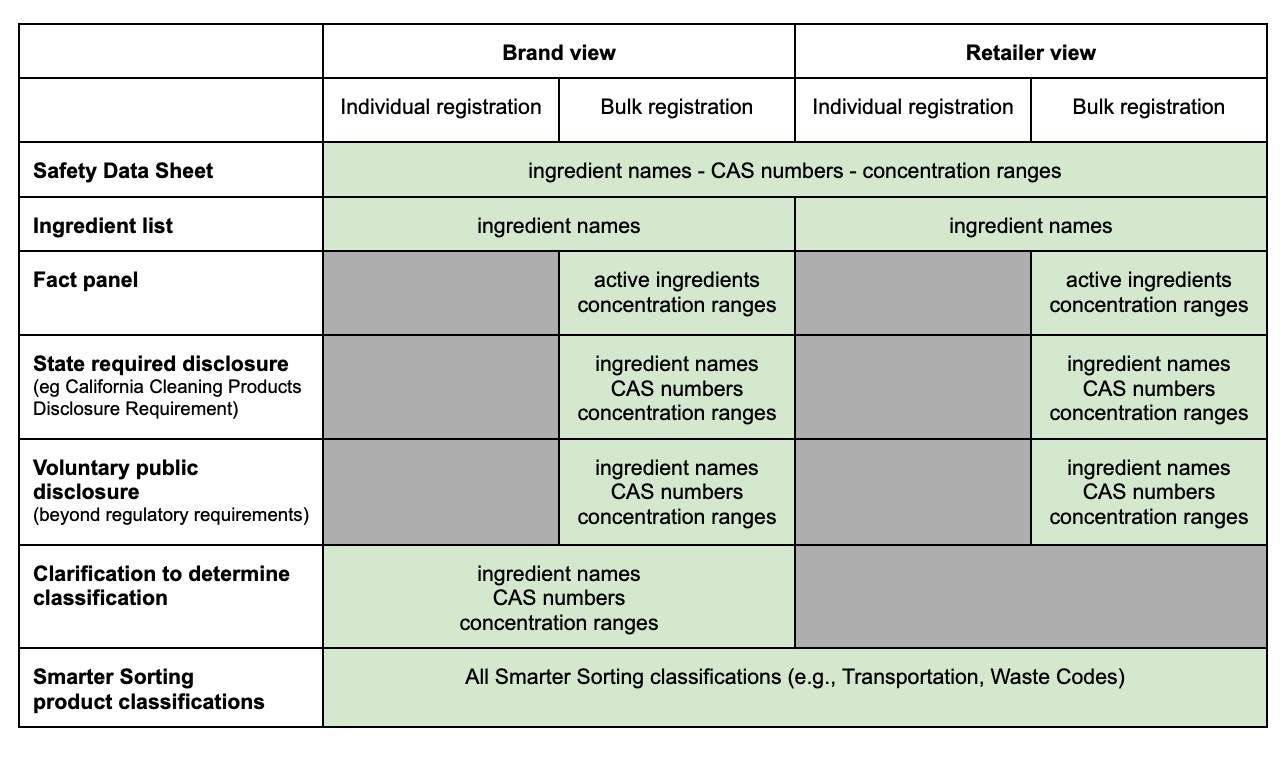
Why is there a difference in information visibility between individual and bulk registration?
- For bulk registration, we have 100% confidence in which data is publicly available because we will work closely with you and your team to identify which information sources to use.
- For individual registration, at first we won’t have the ability to confirm whether your manually entered ingredients data are publicly available (at least not in a scalable fashion). But we’ll make improvements in future releases to address this. To be safe, we will assume the information you have entered manually is confidential to you.
What does “voluntary public disclosure” mean?
- Some brands provide disclosures beyond what is required by regulations. For example, some brands publicly disclose the exact CAS Numbers for each ingredient on their label, others provide detail on their fragrance ingredient names.
- If it’s publicly available data, we’ll work with you to use it. This helps us provide better, faster classifications.
And what about “clarification to determine classification”?
- Sometimes we need to ask follow-up questions about ingredients or concentration ranges. We only ask for this information in order to properly classify your products.
- For example:
- If your ingredient names aren’t found in our dictionaries.
- If your product contains a RCRA regulated ingredient and we need to confirm whether the concentration exceeds the RCRA threshold.
- If your product contains ingredients that contribute to the Marine Pollutant calculation (and we need to tighten concentration ranges to classify the product as Hazard Class 9 or Not Regulated for Transportation).
- We’ll ask as few questions as possible. Between 5 and 10% of products require such clarification. We will always ask ‘smart questions’ based on what we need to know to accurately classify products.
When does this go live?
The Ingredient Disclosure change goes live on May 1, 2022. From this point on, retailers will see only publicly available ingredient data along with product classifications.
Keep registering your products! If you’re working with us to bulk register your products, they will all be processed after the Ingredient Disclosure change has been made in the platform – and before the June 1 registration deadline for Albertsons Companies.
Have more questions?
Please ask us. We want you to have the best experience working with Smarter Sorting!
Still stuck? Contact support or email support@smartersorting.com Either way it lands straight in our ticket queue.